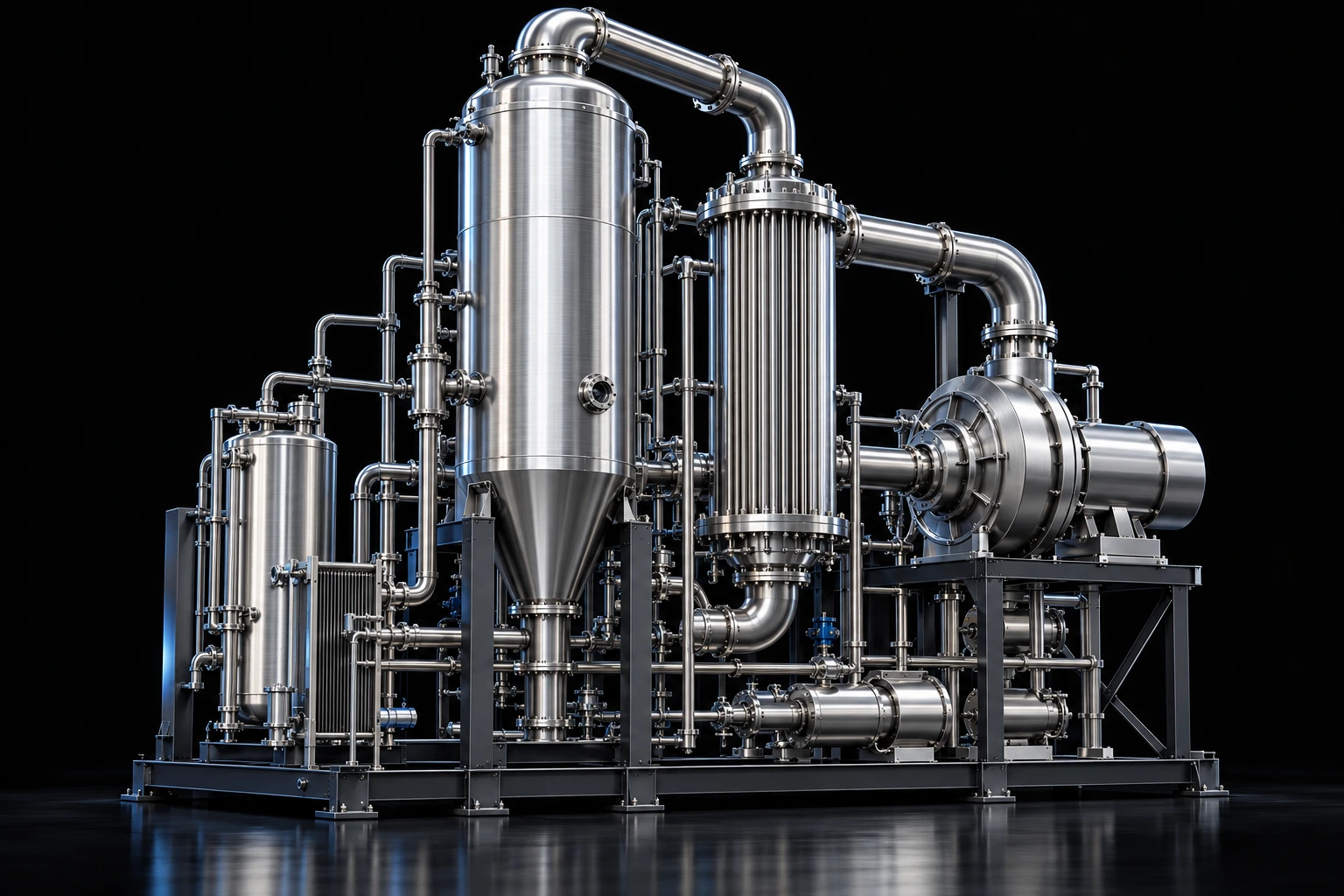
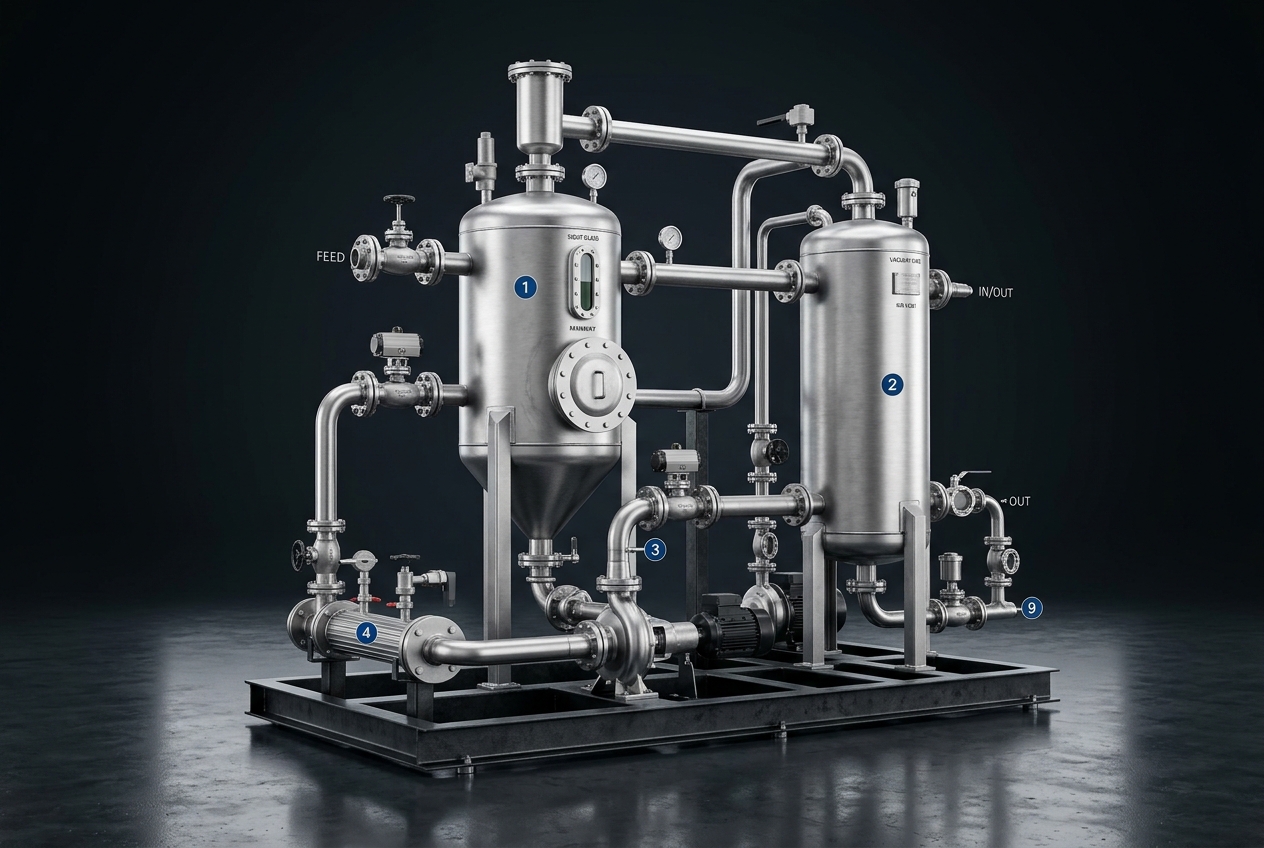
Auxiliaries: start-up heat and non-condensable gas removal.
01 / 05
Feed and circulation
Feed joins the liquid returning from the separator. The circulation pump sends the mixture through the heat exchanger; product is withdrawn through a separate branch.
Scroll or choose a step.
Defined process arrangement, not a final plant design or P&ID. Auxiliary circuits and controls are not detailed. Line crossings without dots are not connections.
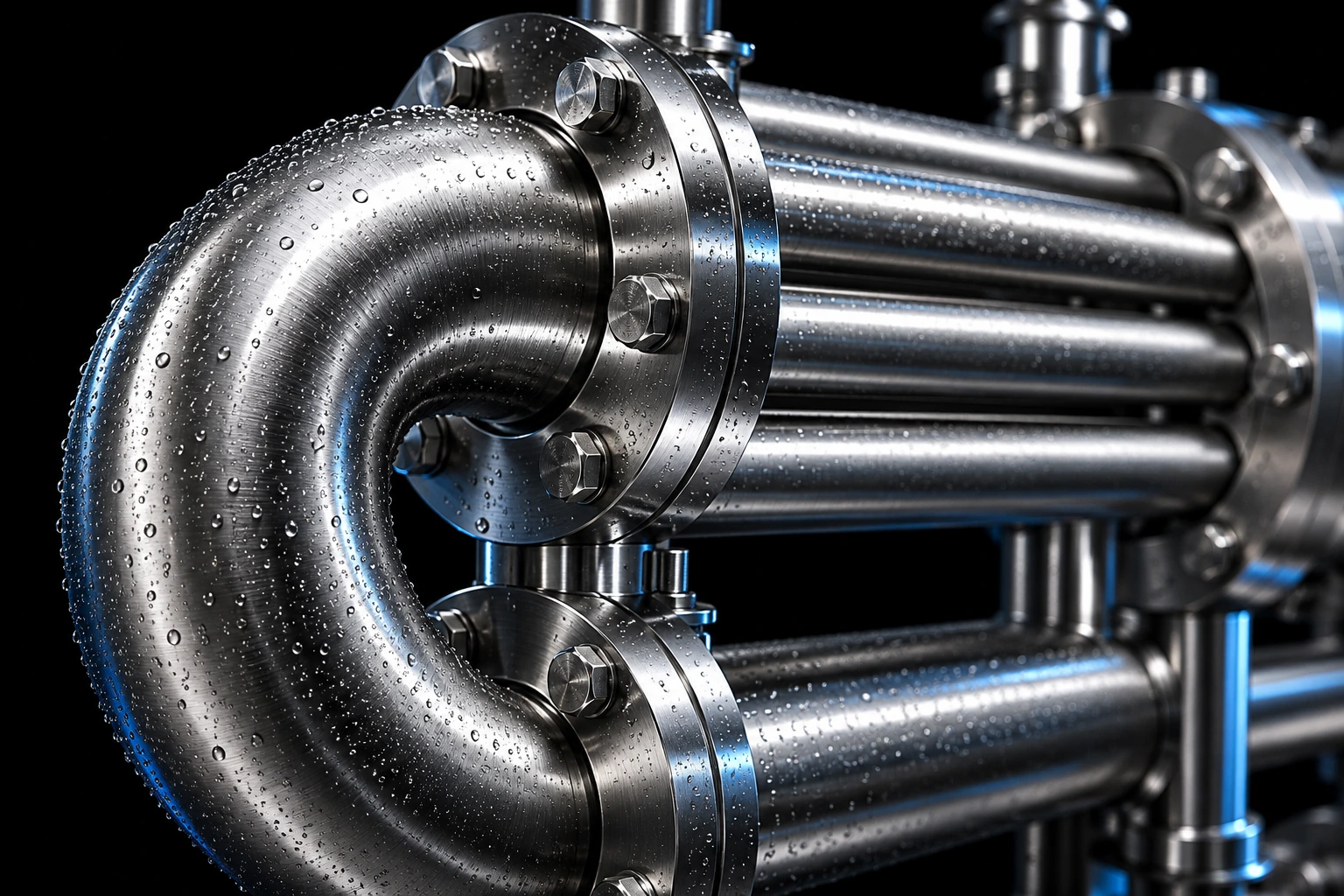
A BIG DIFFERENCE IN SMALL DETAILS.
Closer reveals more.
From materials to maintenance access. Every detail, considered together.
CONCEPT MATERIAL IMAGE
PROSALT DELIVERY MODEL
Engineering, manufacturing and turnkey installation under one roof.
One team considering the entire plant and taking responsibility for your project.
01Engineering+
We define the scope together.
Starting with feed analysis, capacity and product targets, we prepare process, layout and foundation designs. Acceptance conditions and delivery boundaries are defined at the start.
02Manufacturing and integration+
We manufacture in-house and integrate the system.
We manufacture process equipment and structural steelwork in-house. We take responsibility for electrical and automation systems and the integration of selected motors, compressors and instruments.
03Installation and commissioning+
The same responsibility on site.
We coordinate mechanical and electrical installation, system checks and commissioning. Maintenance access and equipment removal space are considered from the design stage.
04Operational handover+
Operation after handover is part of the plan.
Operator training, operating and maintenance documents, critical spares and support scope are defined within the project. Acceptance is assessed against agreed feed and operating conditions.
You prepare the foundations. We provide the design.
The customer carries out concrete and foundation works to the designs and technical requirements provided by PROSALT. PROSALT takes responsibility for equipment, structural steelwork, electrical systems, automation and site installation.
Clear scope. A direct point of contact.
Project contacts, progress updates and site coordination are planned at the outset. Utility connection points, site preparation and local approval responsibilities are clarified in the proposal.
The right choice starts with your process conditions.
Compare MVR, TVR and Flash+
Key differences between MVR, TVR and flash technologies
Criterion
MVR
TVR
FLASH
Operating principle
Mechanical vapor compression
Recompression with a steam ejector
Evaporation by pressure reduction
Main energy input
Steam and electricity
Motive steam
Feed heat / external heating
Selection focus
Electricity price, temperature difference
Steam pressure and cost
Available heat, pressure stages
Key equipment
Compressor or fan
Thermocompressor
Flash vessel and vacuum system
Final selection depends on product analysis, capacity, energy prices and operating conditions. Flash stages may also be combined with other heat recovery methods.
PROCESS ENGINEERING
From solution to product. Consider every stage.
Product targets, available utilities and solution behaviour are assessed together.
01
Energy integration
MVR uses mechanical compression; TVR uses motive steam. In multiple-effect evaporation (MEE), vapour from one effect heats the next. Selection considers the available temperature difference, energy prices and annual operating hours.
02
Evaporator selection
Evaluated for non-precipitating applications requiring short residence times. Forced circulation is evaluated for crystal-bearing or scaling-prone fluids. In circulating crystallizers, boiling inside the heater can be suppressed so evaporation occurs in the separator.
03
Crystal and product quality
Target particle-size distribution is considered alongside supersaturation, residence time and crystal breakage. DTB or growth-type crystallizers are evaluated against this target. Solid-liquid separation and residual moisture determine the load on subsequent drying.
Recrystallization
Recrystallization aims to separate impurities by dissolving solid salt, purifying the solution and forming crystals again. Evaporation or cooling is selected according to solubility behaviour. Mother-liquor recycle and purge are balanced to control impurity accumulation.
Data for process design
Feed ion analysis and variability; flow, temperature, density and viscosity; target purity, particle size and moisture; steam, electricity and cooling conditions; annual operating hours and site constraints. Mass and energy balances, with sample tests where needed, underpin equipment selection.
This content explains general process principles. PROSALT project scope and performance values are determined from feed data and engineering assessment.
Choose your goal first, then continue with the data you know. We can clarify missing information during the technical discussion.
Start with your goal.
02 / PRELIMINARY MASS BALANCE
See the outlet streams.
Example calculation
Feedt/h
Concentrate outlett/h
Water to evaporatet/h
Conserved nonvolatile solutet/h
Method and limitations
Assumes steady state, pure water vapor, complete solute retention, no losses and no crystallization. Percentages are by mass, not volume.
C = F × x₁ / x₂ · V = F − C
F: feed, C: concentrate, V: evaporated water. x₁ and x₂ are initial and target mass percentages of the same component.
This is not a heat balance or equipment capacity guarantee. Target concentration feasibility must be checked against solubility, viscosity and temperature.
03 / TECHNOLOGY SCREENING
What does your energy infrastructure suggest?
This is preliminary screening. Final selection requires product analysis, mass and energy balances, operating hours and energy costs.
Use these inputs to start your technical discussion.
YOUR NEXT CYCLE.
It starts with an idea. Takes shape together.
Tell us about your process. Our engineering team will get in touch.
PROJECT START / 01
What can we make possible?
Application, technology and capacity. Three essentials for the first step.
Your enquiry is emailed directly to [email protected]. No document download is needed.
TECHNICAL DISCUSSION
Let's assess your process together.
Share your feed analysis, target capacity and available energy sources. Our team will help define the next step.
No. Electricity and steam prices, operating hours, boiling point elevation and product properties must be assessed together. Technology selection is project-specific.
How are materials selected?
Chloride content, temperature, pH, corrosion and cleaning conditions determine the choice. Stainless steel grades or special alloys are selected using product analysis and process conditions.
Does evaporation alone achieve zero liquid discharge?
Not always. Zero liquid discharge requires an integrated assessment of pretreatment, evaporation, crystallization and solid–liquid separation.
What information is needed for an initial technical assessment?
Feed flow and composition, initial and target concentration, operating hours, steam and electricity conditions and site layout are the key inputs.
PROSALT
Your privacy, your choice
Choose how we measure site use. Optional services stay off until you choose. Cookie policy